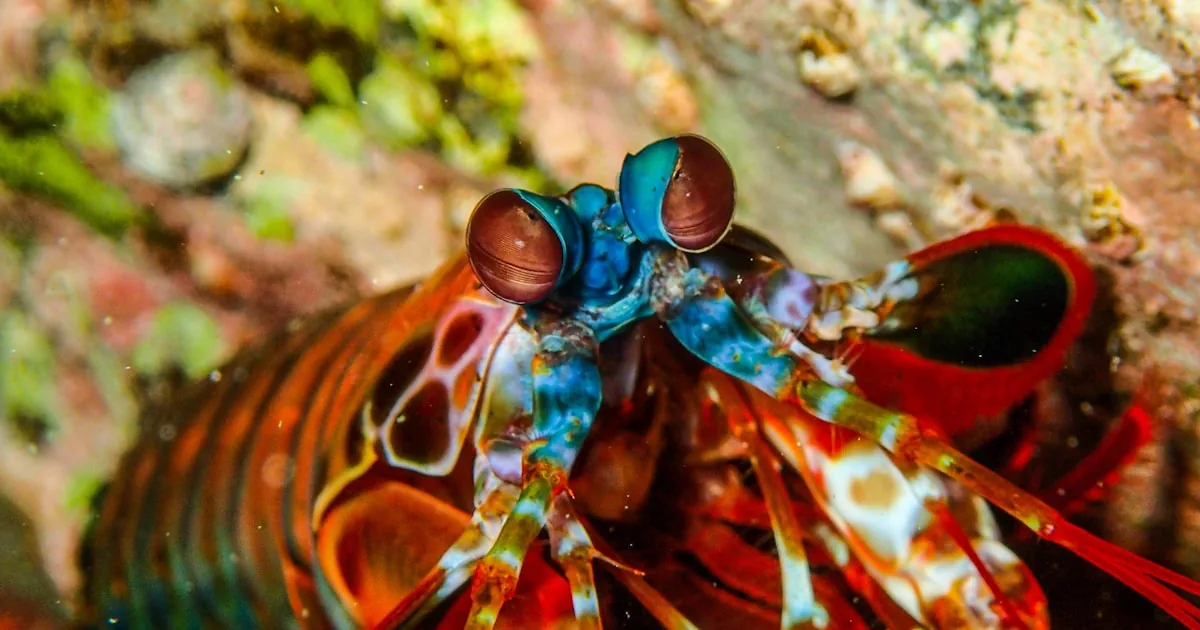
Imagine you are at an underwater boxing match. In the red corner, we have a hard-shelled crab. In the blue corner, wearing an incredibly flashy, multi-colored suit that looks like it was designed by a chaotic artist, we have the peacock mantis shrimp. You might think the crab has the advantage with its heavy armor. But the mantis shrimp is about to throw a punch that defies the laws of everyday physics. This isn’t just a fast punch; it’s a physical strike that literally tears water apart, creates a sun-hot bubble, and emits a flash of light.
The Anatomy of a Bullet Punch
To understand just how ridiculous this creature is, we need to look at the numbers. The mantis shrimp’s club-like appendage can accelerate at over 10,000 Gs, reaching a top speed of around 80 kilometers per hour (50 mph) from a dead stop.
That is the acceleration of a .22 caliber bullet leaving a gun barrel. If a human could accelerate their arm at that rate, they could throw a baseball straight into orbit. But doing this in the air is one thing. Doing it underwater, where the resistance is nearly 800 times greater than air, is where the real magic happens.
Tearing the Water Apart
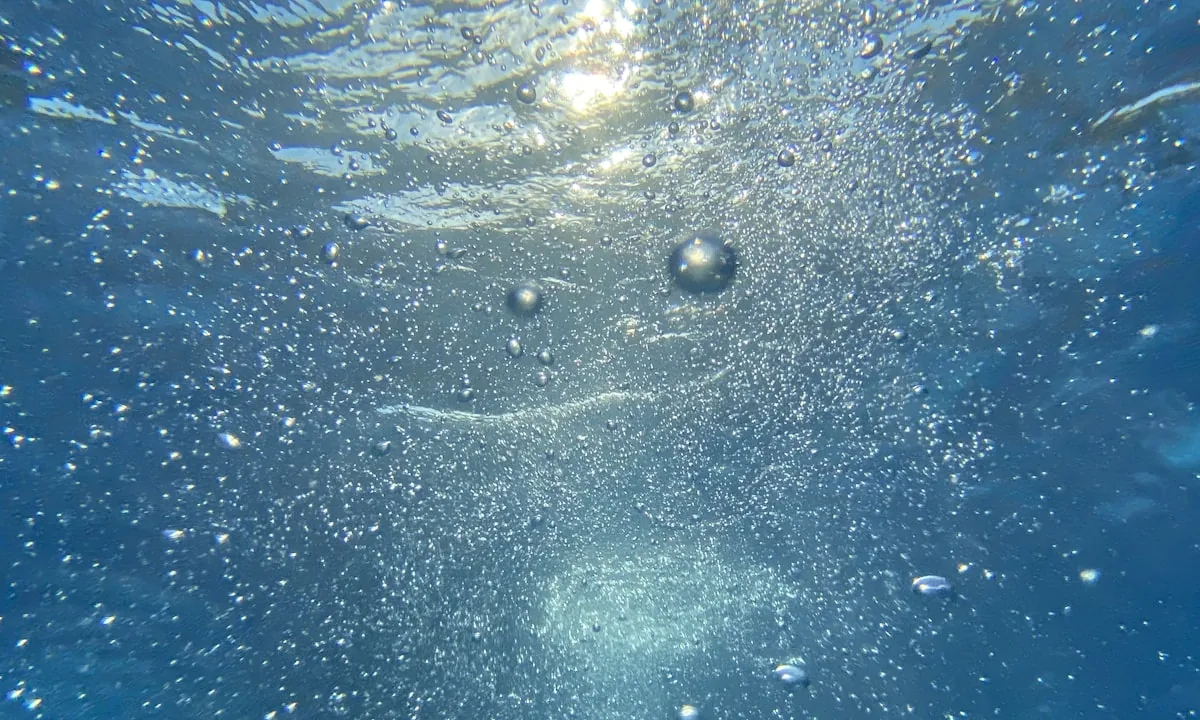
When you move your hand underwater in a swimming pool, the water easily flows around your fingers to fill the empty space left behind. However, the mantis shrimp's club moves so absurdly fast that the water simply cannot get out of the way, nor can it rush back in fast enough to fill the void behind the club. This extreme speed creates a literal tear in the fabric of the water—a tiny pocket of extreme low pressure.
In physics, there is a fascinating rule about pressure and boiling points. We are used to boiling water by adding heat on a stove. But you can also boil water by drastically dropping the pressure. Because the pressure drops so incredibly low behind the shrimp’s club, the water at that exact spot instantly boils at room temperature. This forms a vapor-filled cavity, known as a cavitation bubble. For a fraction of a millisecond, the shrimp has created boiling steam in the middle of the cool ocean just by punching.
Collapsing Suns and Shockwaves

But the ocean does not like empty spaces. The immense pressure of the surrounding deep water immediately crashes back down on this tiny bubble, forcing it to collapse in on itself.
This is where things escalate from bizarre to mind-blowing. As the cavitation bubble implodes, the gases trapped inside are compressed so rapidly and violently that the internal temperature spikes to over 4,000 degrees Celsius (about 7,200 degrees Fahrenheit). To put that into perspective, that is nearly as hot as the surface of the Sun.
This implosion releases a colossal shockwave and even a tiny, brief flash of light—a phenomenon known as sonoluminescence, or "sound light." So, when the mantis shrimp strikes its prey, the unfortunate crab is actually getting hit twice. First, it gets smashed by the physical impact of the club itself. Second, microseconds later, it gets hit by the explosive shockwave of the collapsing, sun-hot bubble. Even if the shrimp misses the target by a hair, the shockwave alone is often enough to stun or kill the prey. It is the ultimate one-two punch.
Why Doesn't the Shrimp Shatter?
At this point, a curious mind might ask a very logical question: If this creature is throwing punches with the force of a bullet and creating exploding, sun-hot bubbles, why doesn’t its own arm shatter into a million pieces? Sir Isaac Newton’s third law reminds us that every action has an equal and opposite reaction. The impact force coming back into the shrimp’s club is immense.
The secret lies in the microscopic architecture of the shrimp’s club. It is not just a solid block of calcium. Instead, it is made of mineralized fibers arranged in a "Bouligand structure"—a complex, overlapping pattern that resembles a microscopic spiral staircase. When the club hits a hard crab shell, micro-cracks form in the club. But instead of splitting the weapon in half, the spiral structure forces the cracks to twist and turn, dissipating the energy and stopping the crack from spreading. It is nature's ultimate shock absorber.
From the Reef to Human Engineering
Today, materials scientists and engineers are studying this exact spiral structure to design lighter, stronger materials for human use. By mimicking the mantis shrimp’s club, researchers are developing improved body armor for soldiers, more durable frames for airplanes, and safer helmets for athletes.
So, the next time you think of scientific marvels, remember that you don't always need to look up at the stars or peer into a particle accelerator. Sometimes, the most astonishing physics in the universe—accelerations matching bullets, water boiling from speed, and tiny suns collapsing in the dark—can be found in a coral reef, engineered into a creature the size of a banana.


Loading comments…