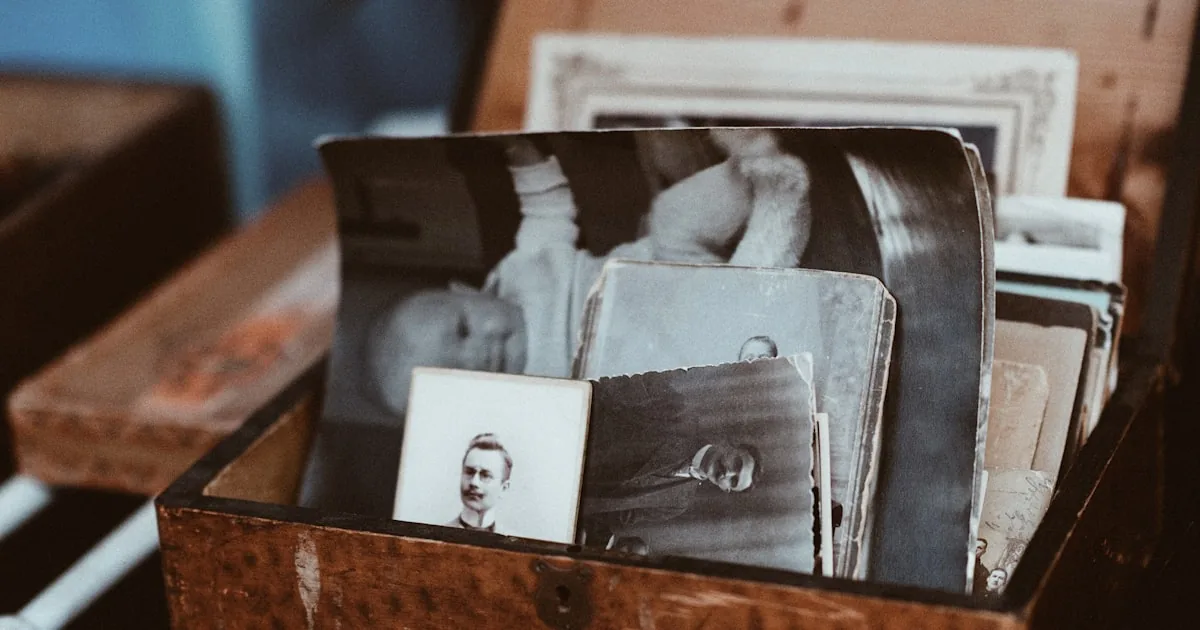
We live in an age that treats forgetting as a failure. We buy extra cloud storage to back up thousands of photographs we will probably never look at again. We screenshot passing conversations to preserve them forever, we meticulously journal our grievances, and we cling tenaciously to our past identities. We are terrified of letting anything slip away, convinced that if we lose our records, we somehow lose ourselves.
But what if the exact opposite is true? What if the inability to let go of the past is the true obstacle to living fully in the present?
Have you ever stopped to notice how heavy the past can feel? When we insist on carrying every regret, every minor slight, every faded triumph, and every resolved conflict, we are walking through life with an invisible, ever-growing backpack. The more we accumulate, the slower we move. The psychological weight of hoarding memories drains our energy for the present moment. We become so preoccupied with cataloging where we have been that we lose sight of where we are going.
The Curse of Total Recall
In his brilliant short story Funes the Memorious, the Argentine writer Jorge Luis Borges imagines a young man named Ireneo Funes who suffers a horseback riding accident and wakes up with a perfect, infinite memory. He remembers the exact shape of every cloud he has ever seen, every leaf on every tree, and every word he has ever heard. He remembers the changing temperature of a Tuesday morning three years ago with perfect clarity.
At first, this condition sounds like a desirable superpower. But Borges quickly reveals it to be a devastating curse. Funes becomes paralyzed by the sheer volume and granularity of his own memories. He is forced to spend an entire day just mentally recalling the events of the previous day. Because his mind is so overwhelmingly cluttered with specific details, he loses the ability to understand broad concepts.
As Borges profoundly writes, "To think is to forget differences, generalize, make abstractions." Funes cannot think; he can only remember. He is suffocated by his own mental accumulation.
Like Funes, when we stubbornly refuse to let the past fade naturally, we trap ourselves in a cognitive prison. We become curators of a dusty museum that no one visits, endlessly polishing old artifacts instead of stepping outside into the sun.
Nietzsche's Concept of Active Forgetting
The philosopher Friedrich Nietzsche saw forgetting not as a weakness of the human brain, but as a vital biological and psychological necessity. In his essay On the Advantage and Disadvantage of History for Life, he observed the way animals graze in a field. They live peacefully because they are entirely unhistorical—they forget immediately and live purely in the present, unbothered by yesterday and unanxious about tomorrow.
Humans, on the other hand, are perpetually haunted by the phrase "it was." Nietzsche argued that in order to be healthy and to flourish, we must consciously develop the capacity for what he called "active forgetting." He wrote, "Forgetting is essential to action of any kind, just as not only light but darkness too is essential for the life of everything organic."
Active forgetting is not about suffering from dementia, nor is it about living in denial of our mistakes. Rather, it is a deliberate, powerful choice. It is the conscious decision not to let a past betrayal indefinitely define your capacity for trust in current relationships. It is the willingness to let your old, outdated self die so that a new, evolving version of you can be born. If you vividly remember every single time you fell down or failed, how can you ever summon the uninhibited courage to try again?
The Stoic Release of the Past
The ancient Stoic philosophers approached the concept of memory through the rigorous lens of control. Epictetus taught that the foundation of peace of mind is drawing a strict line between what is within our power and what is not. The past, by definition, is completely and irrevocably outside our control. No amount of rumination, agonizing regret, or mental replaying of events can alter a single second of what has already happened.
When we constantly revisit old memories—especially painful ones—we are essentially volunteering to suffer twice. We suffer once when the event occurs, and we suffer a hundred times more by dragging it back into the present through our thoughts. The Stoic practice is to acknowledge the past without hiding from it, extract the necessary lesson, and then deliberately release the emotional weight attached to it. Seneca often reminded his readers that the present time is all we ever truly possess. To waste it looking backward is the ultimate tragedy of human existence.
Clearing the Canvas for Tomorrow
Think of your mind as an artist's canvas. If you never erase the old sketches, if you insist on keeping every line you have ever drawn, eventually, the canvas becomes a dark, chaotic mess of overlapping ink. You cannot possibly paint a vibrant new masterpiece on a surface that has no empty space remaining.
We must learn to trust that letting go of a memory does not mean losing a fundamental part of ourselves. The experiences that truly matter have already done their work; they have shaped our character, altered our perspectives, and baked themselves into the foundation of who we are today. We do not need to consciously hold onto the temporary scaffolding once the permanent house has been built.
To forget is to forgive yourself. To forget is to intentionally make room for tomorrow. Perhaps it is time to finally take off that heavy, invisible backpack, leave it gently by the side of the road, and take a bold step forward, unburdened, light, and free.


Loading comments…