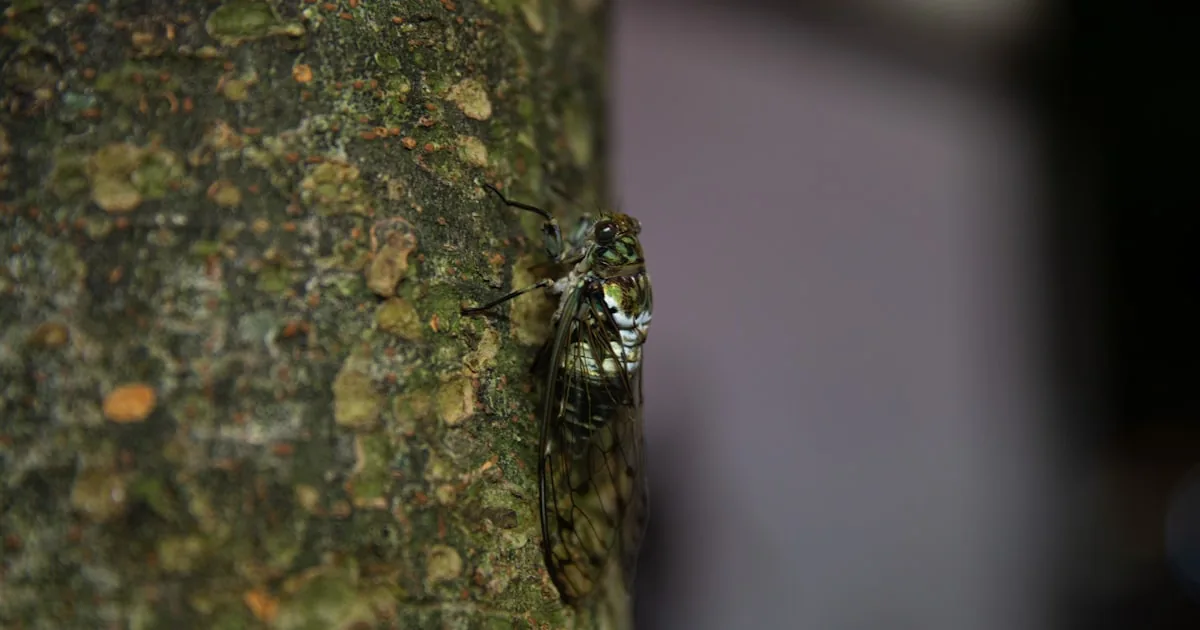
If you have ever spent a summer in the eastern United States, you might have witnessed one of nature’s most overwhelming spectacles: the emergence of the periodical cicadas. Almost overnight, millions of these winged insects erupt from the soil, clinging to every available branch, trunk, and fence post. Their collective mating song creates a deafening roar that can reach 100 decibels—as loud as a lawnmower running right next to your ear.
But it isn't just their sheer numbers that make them fascinating. It is their timing.
Unlike the green annual cicadas that appear every summer, the dark-bodied, red-eyed periodical cicadas belong to the genus Magicicada. They spend the vast majority of their lives hidden deep underground as wingless nymphs. When they finally emerge, they follow a schedule that seems utterly bizarre: they appear exactly every 13 years, or exactly every 17 years.
Not 12. Not 15. Not 16. Only 13 and 17.
To a biologist, this is a fascinating life cycle. To a mathematician, however, these numbers immediately jump out for a very specific reason: they are prime numbers. They are only divisible by one and themselves. As it turns out, the cicadas’ choice of 13 and 17 is not a random coincidence. It is an evolutionary shield woven from pure mathematics.
The Metronome of Predators
To understand why prime numbers are so powerful, we have to look at how predator populations fluctuate. In nature, predator and prey populations often operate on cyclical booms and busts. Suppose a forest is home to a species of bird or wasp that loves to eat cicadas. These predators might experience a population boom every 2, 3, 4, or 6 years.
Imagine if the cicada had chosen a 12-year life cycle. The number 12 is a highly divisible number. It can be divided by 2, 3, 4, and 6. If a predator population booms every 4 years, every single time the 12-year cicadas emerge from the ground, they would be met by a massive wave of hungry predators. It would be a slaughter.
Think of it like two interlocking gears. If the predator gear has 4 teeth and the cicada gear has 12 teeth, the exact same teeth will click together on every single rotation of the larger gear. You and your enemy are perfectly synchronized.
The Prime Number Shield

This is where the magic of prime numbers comes into play. By evolving to emerge every 13 or 17 years, cicadas throw a massive mathematical wrench into the predators' gears.
Because 13 and 17 cannot be evenly divided by any smaller numbers, it is incredibly difficult for a cyclical predator to synchronize with them. We calculate this using the Lowest Common Multiple (LCM).
If a predator has a 4-year boom cycle and the cicada emerges every 13 years, the two populations will only clash at their peaks every 52 years (4 x 13). If the predator has a 5-year cycle, they will only meet every 65 years. And if a predator tried to track the 17-year cicada with a 5-year cycle, they would only face a synchronized disaster once every 85 years!
By hiding in the prime numbers, cicadas ensure that their emergence almost never coincides with a predator boom. By the time a predator population swells in response to a cicada feast, the cicadas are long gone, sleeping underground for another decade and a half. The predators simply starve and their numbers crash, unable to sustain themselves without their prime-numbered prey.
The All-You-Can-Eat Buffet

When the prime-number alarm clock finally rings, the cicadas employ a second survival strategy: predator satiation.
They don't just sneak out of the ground; they flood the forest in apocalyptic numbers. In some areas, there can be up to 1.5 million cicadas per acre. When birds, raccoons, squirrels, and even dogs realize the feast has begun, they gorge themselves. They eat until their stomachs are stretched to the limit, until they literally cannot swallow another bug.
And that is exactly the point. The local predators can eat thousands upon thousands of cicadas, but they are just a tiny drop in the bucket. Because the cicadas appear so rarely, no predator species could ever build up a population large enough to make a dent in a swarm of millions. The survivors casually climb up the trees, shed their exoskeletons, grow wings, and sing their deafening songs of victory, completely unbothered by the bloated predators sleeping below.
How Do They Count to Seventeen?
This raises one final, beautiful mystery: how on earth does a bug count to 13 or 17 while buried in the dark, without a calendar, a watch, or even the sun?
The answer lies in the trees. While underground, the cicada nymphs attach themselves to the roots of deciduous trees and sip the xylem fluid. Trees have a very strict annual rhythm. In the spring, when the leaves bud, the tree sends a flush of sugar and nutrient-rich fluid down to the roots. In the winter, the flow stops.
The cicadas aren't counting years; they are tasting the seasons. Every surge of spring sap is registered as one "tick" of their biological clock.
Scientists actually proved this in a clever experiment. They moved 15-year-old cicada nymphs into a greenhouse and artificially altered the light and temperature to trick the trees into going through two distinct "spring" cycles in a single year. The trees flushed sap twice. The cicadas counted both flushes, thought two years had passed, and emerged from the ground a year earlier than they were supposed to!
The Elegance of Nature
Nature is often viewed as a brutal physical struggle—a world of sharp claws, fast legs, and camouflage. But the story of the Magicicada reminds us that evolution is also a brilliant mathematician.
The next time you find yourself surrounded by the chaotic, overwhelming screech of a summer cicada swarm, take a moment to appreciate what you are really witnessing. It isn't just a bug infestation. It is a biological calculation, a prime-number shield perfected over millions of years, proving that sometimes, the best way to survive is simply doing the math.



Loading comments…