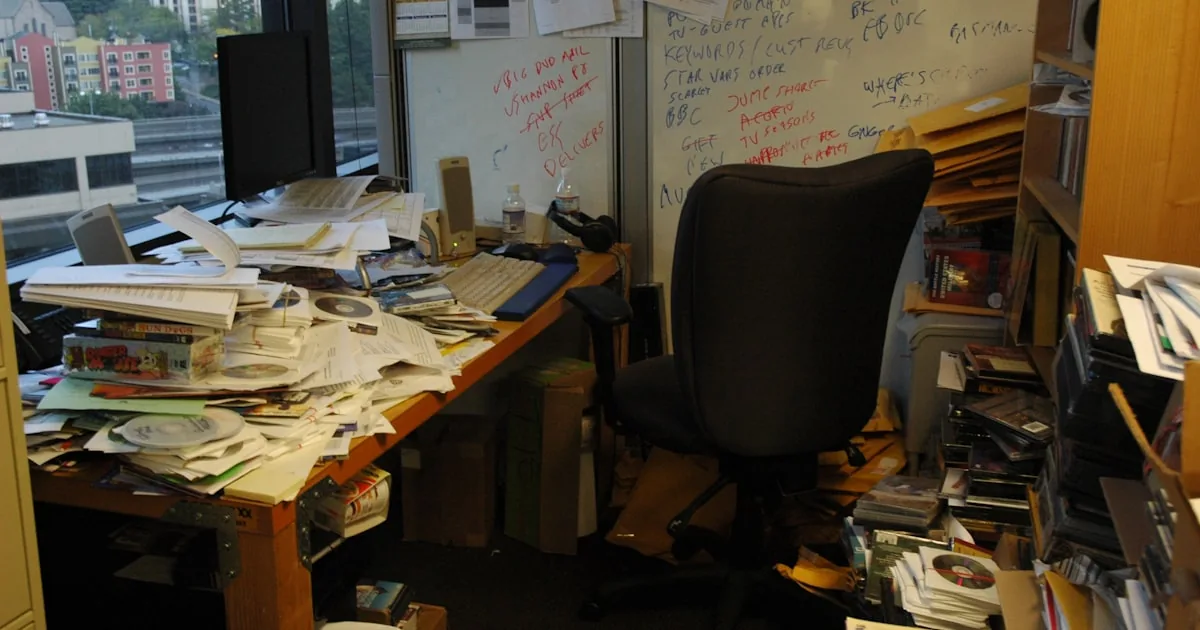
Do you find yourself reading the same emails twice or moving the same clutter around your house? The 'Touch It Once' rule is a powerful productivity habit designed to stop double-processing and save your mental energy.
Have you ever picked up your phone, read an email from a client, thought, "I need to look into this," and then marked it as unread?
Later that evening, you open the same email again, re-read it to refresh your memory, and finally write the reply.
Or how about your physical space? You come home, take off your jacket, and toss it on a chair. The next morning, you pick it up from the chair and finally hang it in the closet.
In both scenarios, you didn't save any time by putting off the final action. In fact, you did the exact opposite. You spent time and mental energy interacting with the exact same object or piece of information twice. This habit of deferring small decisions is a silent killer of productivity.
The antidote to this is a remarkably simple but effective concept: The 'Touch It Once' Rule.
What is the 'Touch It Once' Rule?
Originally known in time-management circles as OHIO (Only Handle It Once), the premise is straightforward: when you encounter a piece of information or an object, you do not put it down until you have made a decision about it and taken the necessary action.
You don't pick up a piece of mail, look at it, and put it in a pile to be sorted later. You open it, recycle the envelope, and either pay the bill, file the document, or throw it away. You touch it once.
This rule isn't about rushing. It is about being deliberate with your attention. It forces you to stop using your environment—like your email inbox, your desk, or your kitchen counter—as a temporary holding zone for delayed decisions.
The Hidden Tax of "I'll Do It Later"

Why is double-handling so detrimental? It seems harmless to leave a dish in the sink to wash after dinner, or to leave a message on "unread."
But every time you defer a small task, you are paying a hidden tax in two currencies: time and mental clarity.
1. The Time Tax
When you read an email and decide to reply later, you have to spend time reading it again. You have to re-evaluate the context. If it took you 30 seconds to read it the first time, and 30 seconds to read it the second time, you have doubled the time required just to prepare to do the work.
2. The Cognitive Load
Every deferred decision becomes a tiny weight in the back of your mind. You know you have emails to reply to. You know you have clothes to hang up. Even if you aren't actively thinking about them, they act like background apps draining your smartphone's battery. The more "pending" items you have, the more overwhelmed you feel, leading to stress and decision fatigue.
Applying "Touch It Once" to Your Digital Life
Our digital lives are ground zero for the double-handling trap. Here is how to apply the rule to your screens:
- Email and Messaging: Never open an email or a message unless you are in a position to process it. If you are standing in line for coffee and only have two minutes, don't open an email that you know will require a thoughtful response. When you do open your inbox, touch every email once: Reply, Delete, Archive, or—if it requires deep work—schedule a specific time on your calendar to do that work.
- File Management: When you download a document, don't let it sit in the chaotic abyss of your "Downloads" folder. Save it directly to the appropriate project folder with a clear file name.
- Reading Articles: If you find an interesting article while working, don't leave the tab open for three days. Either read it right then, or save it immediately to a read-it-later app like Pocket or Instapaper, and close the tab.
Applying "Touch It Once" to Your Physical Space
The rule is just as powerful when applied to your physical environment. Clutter is rarely the result of a single catastrophic event; it is the accumulation of hundreds of deferred decisions.
- The Kitchen: Instead of placing a dirty plate in the sink to be washed later, wash it immediately or put it directly into the dishwasher. The time it takes to move it to the sink is almost identical to the time it takes to put it in the dishwasher.
- The Mailbox: Sort your mail while standing over the recycling bin. Throw away the junk immediately. Put bills in the specific place where bills are paid.
- Your Wardrobe: When you take off your clothes, they go into the laundry basket or onto a hanger. They never go onto "the chair."
The Exception: Complex Projects
A common misunderstanding of the 'Touch It Once' rule is thinking you have to complete massive projects the second you encounter them. If your boss hands you a 50-page report to review, you obviously cannot finish it in one touch.
The rule applies to processing and decision-making, not necessarily execution of large tasks. For a big project, "touching it once" means looking at it, deciding what the very next physical action is, and scheduling time for that action. You have made the decision. You have processed the input. You don't have to keep staring at it and wondering what to do.
Start Small Today
You don't need to overhaul your entire life overnight. The beauty of the 'Touch It Once' rule is that it can be applied immediately to the smallest areas of your day.
The next time you find yourself holding a piece of paper, reading a notification, or taking off your shoes, catch yourself before you put it in a "temporary" spot. Ask yourself: Can I deal with this right now?
Make the decision. Take the action. Touch it once, and let it go. You will be amazed at how much time and mental space you reclaim.


Loading comments…