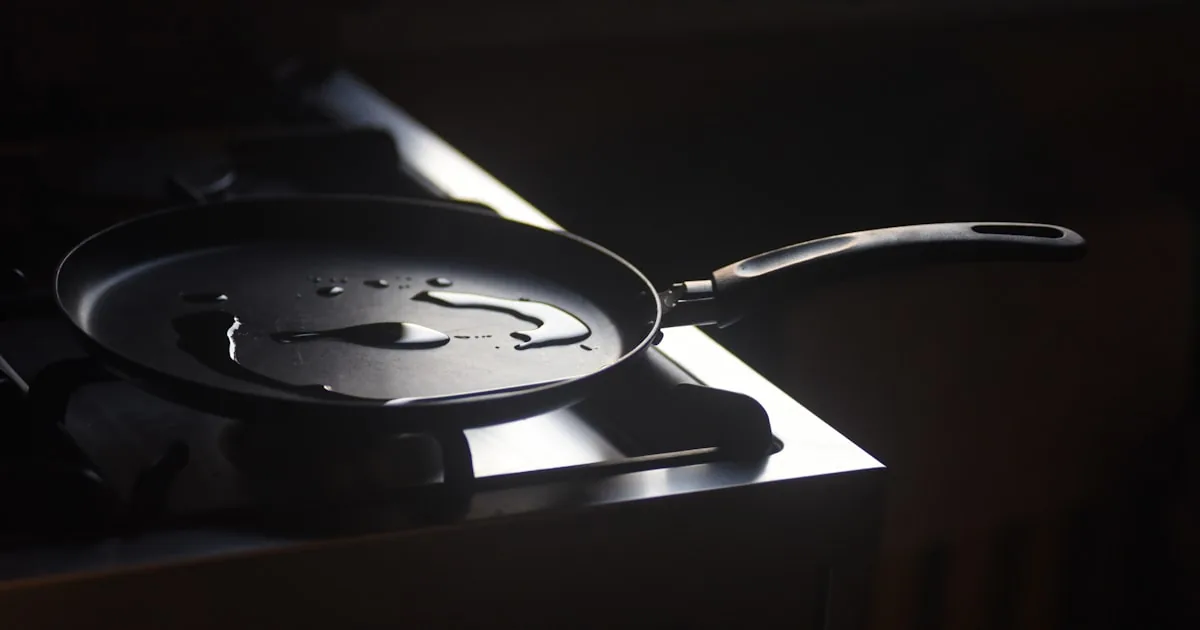
Have you ever flicked a few drops of water onto a hot skillet while preparing breakfast? If the pan is only moderately warm, the water sizzles noisily and vanishes into thin air within seconds. But if the pan is screamingly hot, something bizarre happens. Instead of evaporating instantly, the water beads up into shiny, smooth spheres that glide effortlessly across the metal surface like tiny hockey pucks on ice.
It feels completely counterintuitive. Why would water take longer to disappear on a pan that is significantly hotter?
This everyday kitchen mystery is governed by a fascinating physics phenomenon known as the Leidenfrost effect. Named after the 18th-century German doctor and theologian Johann Gottlob Leidenfrost, this principle reveals how extreme heat can unexpectedly transform liquid into a levitating acrobat.
The Microscopic Air Mattress
To understand what is happening on your stove, imagine trying to walk across hot coals wearing shoes made of dry ice. The moment your soles hit the heat, gas erupts beneath you, creating a temporary cushion.
When a drop of water touches a metal surface heated well beyond its boiling point—typically above 193°C (379°F) for water on steel—the bottom-most layer of the droplet doesn't just warm up. It vaporizes instantaneously in a micro-fraction of a second.
This instant evaporation produces a thin pocket of trapped steam right beneath the droplet. Rather than letting the rest of the liquid contact the scorching metal, this steam barrier lifts the droplet off the surface. The water is no longer sitting on hot metal; it is floating on its own self-generated cushion of vapor.
Because the droplet is floating on gas, friction drops to nearly zero. The slightest tilt of the pan or ambient breeze sends the water bead skittering across the surface like a miniature hovercraft.
Why Heat Transfer Slows Down
The real paradox of the Leidenfrost effect lies in thermodynamics. We naturally assume that higher temperatures always mean faster heat transfer. However, steam is a notoriously poor conductor of heat compared to liquid water or solid metal.
Once that insulating vapor blanket forms beneath the droplet, it acts like a thermal thermos. The intense heat from the pan struggles to penetrate the steam barrier to reach the liquid above. Consequently, the rest of the droplet evaporates at a remarkably sluggish pace.
If you place water on a pan heated to 120°C, it boils away in seconds because it makes direct contact with the hot surface. But bump that temperature up to 220°C, and the Leidenfrost effect kicks in, allowing the droplet to survive for up to a minute while dancing across the skillet.
The threshold temperature where this phenomenon begins is called the Leidenfrost point. It varies depending on the liquid, the smoothness of the surface, and atmospheric pressure, but its signature behavior remains unmistakable.
From Kitchen Pans to Liquid Nitrogen
The Leidenfrost effect isn't limited to water drops in a kitchen. You can observe the exact same physics whenever there is a dramatic temperature difference between a liquid and its surroundings.
If you spill liquid nitrogen onto a room-temperature floor, it doesn't form a puddle. Because room temperature (around 20°C) is more than 200 degrees hotter than the boiling point of liquid nitrogen (-196°C), the liquid nitrogen immediately forms a Leidenfrost vapor layer. Droplets of liquid nitrogen scatter across the floor like scattered glass marbles, skittering until they slowly vanish.
Extreme stunt performers have even used this phenomenon to briefly dip wet hands into molten lead or liquid nitrogen without instant injury. The moisture on their skin flashes into a protective vapor shield for a fraction of a second. (Though it goes without saying: please do not try this at home!)
Harnessing Levitating Liquids in Engineering
While the Leidenfrost effect is fun to watch while cooking eggs, it poses serious challenges and fascinating opportunities for engineers.
In industrial manufacturing and metallurgy, rapid cooling—known as quenching—is essential for hardening metals. If a red-hot steel beam is plunged into water, a Leidenfrost steam blanket can quickly wrap around the metal, insulating it and slowing down the cooling process. Engineers must agitate the liquid or add additives to break the vapor layer and ensure uniform cooling.
Similarly, in nuclear reactors and high-performance computer cooling systems, preventing an unwanted Leidenfrost barrier is critical to avoiding catastrophic overheating.
On the cutting edge of science, researchers are finding clever ways to direct these levitating droplets. By micro-engineering surfaces with ratchet-like sawtooth patterns, scientists can force Leidenfrost droplets to climb uphill or navigate complex mazes automatically. As the steam escapes directionally through the grooves, it propels the droplet forward like a tiny steam engine without any moving mechanical parts.
A Marvel Hidden in Plain Sight
Science is often portrayed as something confined to sterile laboratories and particle colliders. Yet, the Leidenfrost effect reminds us that profound physical principles are constantly hiding in plain sight within our daily routines.
The next time you test a hot pan with a splash of water, take a moment to appreciate what you are seeing. That tiny, dancing droplet isn't just surviving extreme heat—it is performing a masterclass in thermal levitation, riding its own cloud of steam across your kitchen counter.


Loading comments…