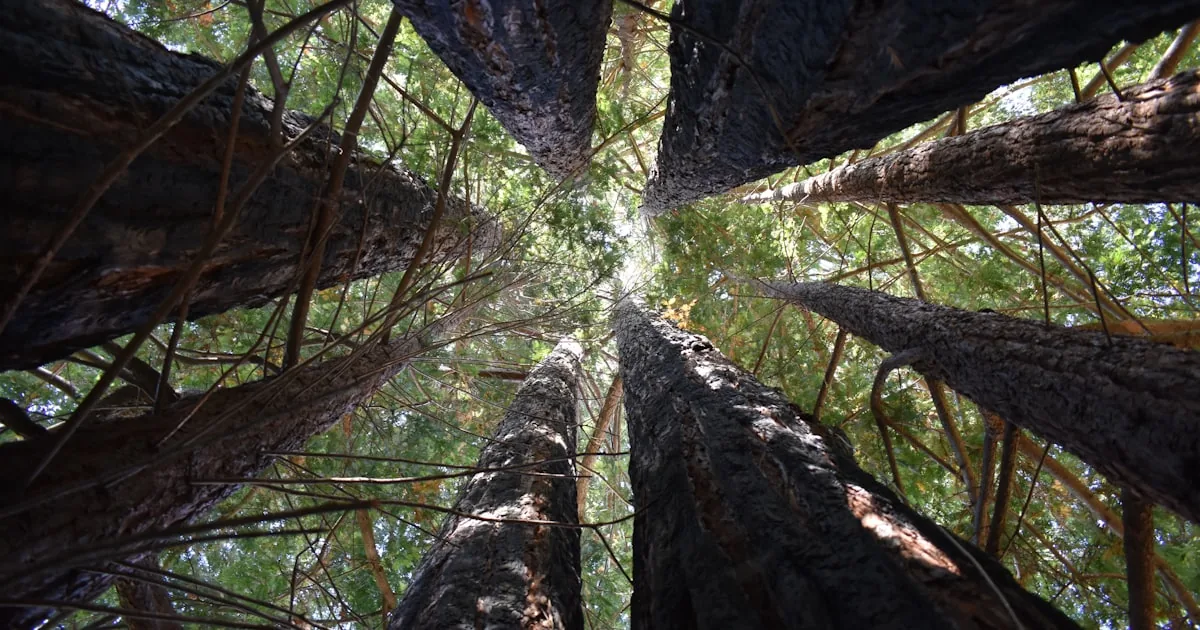
If you have ever tried drinking a thick milkshake through a very long straw, you know how hard your lungs have to work. In fact, if you tried using a straw longer than 10 meters, basic laws of physics would prevent you from getting a single drop, no matter how hard you sucked. Yet giant sequoia and redwood trees routinely pull hundreds of gallons of water more than 100 meters (300 feet) straight up into the air every single day.
How do these living skyscrapers manage such a massive hydraulic feat without a single mechanical engine, electrical grid, or moving part? The answer lies in a mind-bending physical phenomenon: trees pull water by stretching it into liquid ropes under negative pressure.
The 10-Meter Limit of Suction
To understand how impressive trees are, we first need to look at why drinking through a straw has a hard limit. When you suck through a straw, you are not actually pulling the liquid up. Instead, you are removing air from inside the straw, creating a lower pressure zone. The surrounding atmospheric pressure pushing down on the drink in your cup then forces the liquid up into your mouth.
Because sea-level atmospheric pressure is about 1 atmosphere (101.3 kPa), it can only support a column of water that is roughly 10.3 meters high. If you construct a straw taller than 10.3 meters and pull a total vacuum at the top, the water column will simply stop rising. If you try to pull even harder, the water at the top of the straw will spontaneously boil into vapor at room temperature because the local pressure drops to zero.
By all standard rules of atmospheric suction, no tree on Earth should be able to grow taller than 10 meters and survive. So how do redwoods reach 115 meters?
Water as a Steel Cable
Trees do not push water from the roots, nor do they use atmospheric suction from the top. Instead, they exploit two unique chemical traits of water molecules: cohesion and adhesion.
Water molecules ($H_2O$) are polar, meaning one side carries a slight negative charge while the other carries a positive charge. This causes water molecules to stick to one another through strong hydrogen bonds. This mutual attraction is called cohesion. At the same time, water molecules stick to the cellulose walls of the tree's internal plumbing—a vast network of microscopic dead cells called the xylem. This is known as adhesion.
Inside the xylem's narrow channels, which can be narrower than a human hair, water molecules link together head-to-tail. Rather than behaving like loose ping-pong balls floating in a pipe, the water molecules bind together into unbreakable, continuous microscopic threads running all the way from the deepest root tip to the highest leaf. In essence, the water inside a tree acts less like a fluid and more like a solid steel cable.
The Solar Engine and Negative Pressure
If the water forms a continuous cable, what pulls the cable upward? The engine driving this system is the sun.
Leaves are covered with thousands of microscopic pores called stomata. During the day, these pores open to absorb carbon dioxide for photosynthesis. As they open, water inside the leaf cells evaporates into the dry air—a process known as transpiration.
As a single water molecule evaporates from a stomata pore, its exit creates a microscopic tug on the molecule behind it. Because of cohesion, that molecule pulls the next one, which pulls the next, cascading all the way down the trunk to the roots.
This process generates what physicists call negative pressure or mechanical tension. While positive pressure pushes outward and zero pressure represents a vacuum, negative pressure means the liquid is literally being stretched under tension. Inside a 100-meter tree, the water in the xylem can experience negative pressures of -15 to -20 atmospheres. The liquid inside the trunk is under so much tension that if you cut into an active xylem vessel, air will violently rush inward rather than water leaking outward.
Defending Against the Deadly Air Bubble
Operating under intense negative pressure is extremely effective, but it comes with a major physical hazard: cavitation.
If the tension in the water column becomes too great—such as during a severe drought or when the trunk freezes—a microscopic bubble of air can be sucked into the xylem vessel. Under negative pressure, this bubble expands instantly in an explosive event called an embolism or cavitation. The sudden collapse of tension snaps the liquid rope, rendering that specific xylem pipe permanently useless.
To prevent a single air bubble from destroying the entire tree, plant evolution came up with a brilliant structural solution. Xylem vessels are divided into small compartments connected by micro-porous pit membranes. These membranes act as safety valves: they allow liquid water to flow freely between adjacent pipes, but their microscopic pore size creates enough surface tension to block air bubbles from passing through. If one column suffers an embolism, the tree simply routes the water sideways around the blockage.
Nature’s Quiet Masterpiece
When you stand beneath a giant redwood, you are looking at a masterclass in passive engineering. Without a heart to pump fluid, without electricity, and without a single moving mechanical valve, a tall tree lifts tons of water against the relentless pull of gravity every day.
By turning liquid water into tensile ropes powered by solar evaporation, nature solves a hydraulic problem that humbilingly baffles our conventional vacuum technology. It is a striking reminder that sometimes, the most profound physics experiments are happening quietly right above our heads in the forest canopy.


Loading comments…