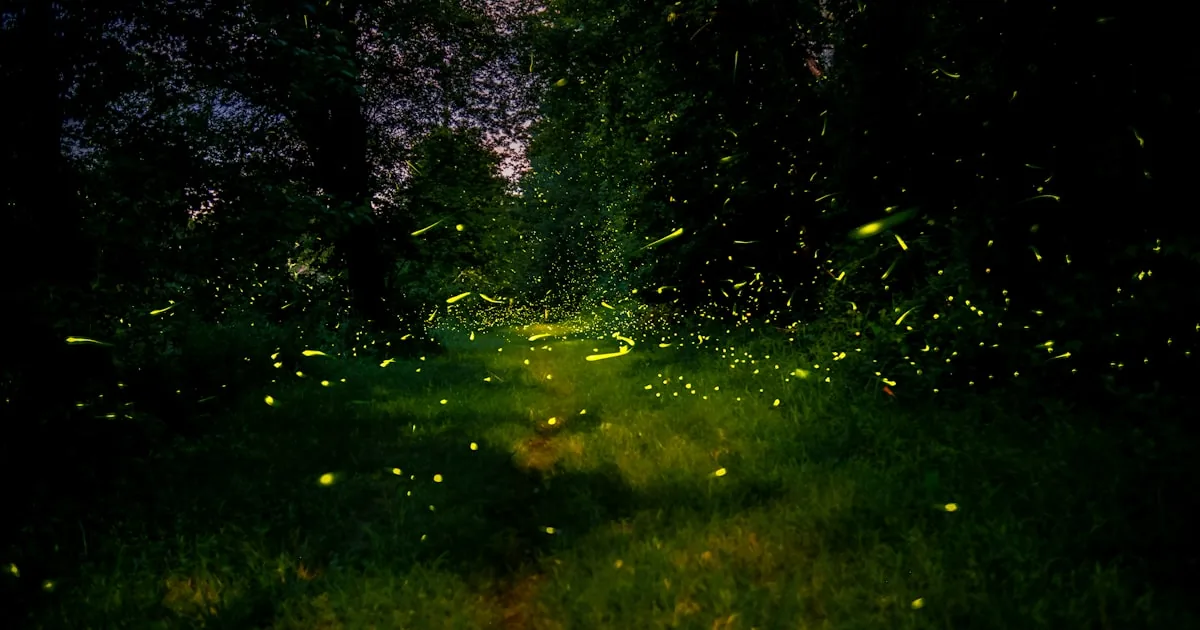
Imagine standing in the humid, thick darkness of the Great Smoky Mountains National Park, or deep in a mangrove forest in Southeast Asia. As twilight fades, the forest begins to twinkle. At first, it's just a chaotic, random scattering of tiny bioluminescent sparks, like the static on an old television screen. But if you wait patiently, something magical and slightly eerie begins to happen.
A rhythm emerges. Small clusters of fireflies start flashing together. The clusters grow, merging with others. Within half an hour, the chaos vanishes. Instead, thousands—perhaps millions—of insects are flashing in absolute, perfect unison. The entire forest pulses with light: Flash. Darkness. Flash. Darkness. It is a silent symphony, performed on a massive scale.
For a long time, Western scientists who heard reports of these synchronous fireflies dismissed them as myths or optical illusions. How could primitive insects, with brains the size of a grain of sand, possibly coordinate across vast distances? There is no conductor in the forest, no "lead firefly" keeping time, and they certainly can't see the entire swarm at once. So, how do they do it?
To understand the why, we have to look at biology. To understand the how, we must dive into a fascinating realm of mathematics called "coupled oscillators."
The Billboard Effect
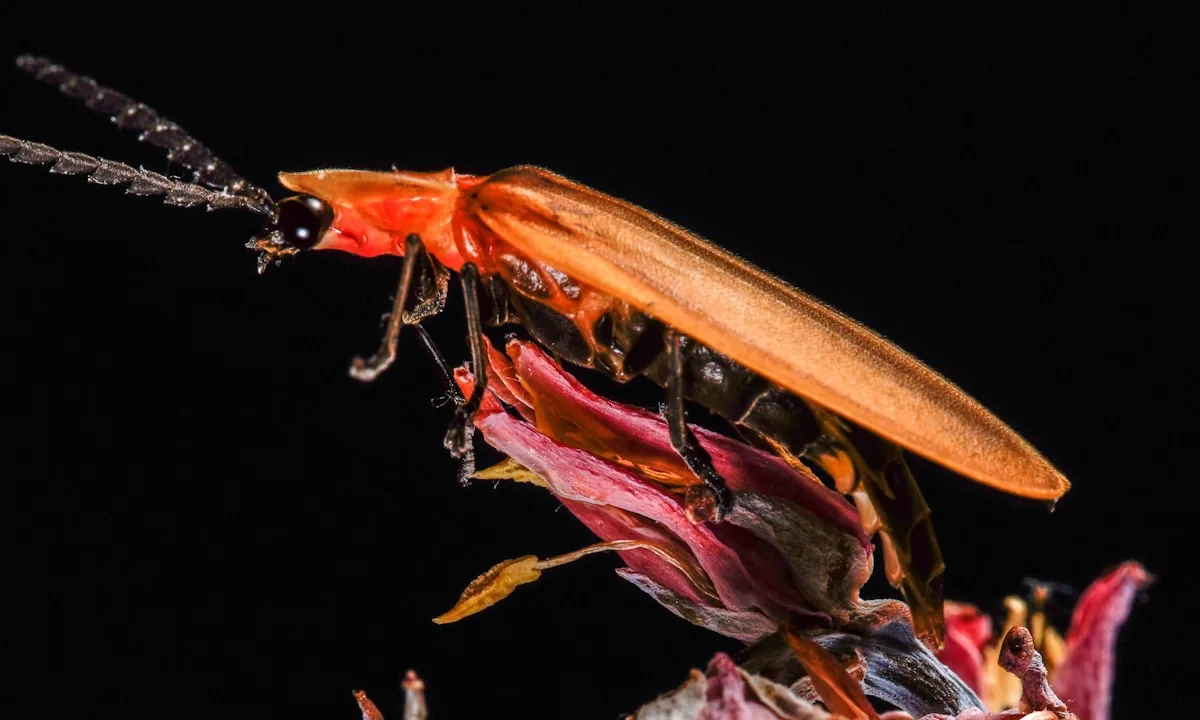
First, why go through the trouble? For male fireflies of species like Photinus carolinus, flashing is a mating display—a way to shout, "I'm here, and I'm looking for a partner!" Females rest on the ground, watching the display above.
If every male flashed randomly, the forest would be a blinding, noisy mess of visual static. A female would have a hard time picking out a specific pattern, and a male's signal would easily get lost in the crowd. By synchronizing their flashes, the males create a unified, pulsating neon billboard. It ensures that their specific species' signal cuts through the visual noise of the forest. When the males go dark in unison, it gives the females a clear window of pitch-black contrast to flash their own subtle response.
The Math of the Wobbly Board
But the mechanism behind this coordination is the true marvel. For decades, it baffled researchers. It wasn't until scientists and mathematicians, like Steven Strogatz, began studying "spontaneous order" that the secret was unlocked.
Imagine a room full of old-fashioned mechanical metronomes. If you start them all at different times, they will tick chaotically. But if you place all those metronomes on a suspended piece of wood—or a wobbly platform that can move back and forth—something incredible happens. As each metronome ticks, it transfers a tiny amount of physical energy to the board. The board sways slightly, and that sway pushes back against the other metronomes, nudging their pendulums. Within minutes, every single metronome on the board will lock into perfect synchronization.
This phenomenon is known as "coupled oscillators." An oscillator is simply anything that repeats a cycle at a regular interval (like a pendulum, or a firefly's flashing mechanism). When these oscillators are "coupled"—meaning they can interact and influence each other, even slightly—they have a natural mathematical tendency to sync up.
The Internal Nudge
A firefly isn't a metronome on a board, but it operates on the exact same principle. Each male firefly has an internal biological clock governing his flash cycle. However, this clock isn't rigid; it's adjustable.
When a firefly is about to flash, it looks at its immediate neighbors. If a neighbor flashes just a fraction of a second before he does, our firefly’s brain registers the light and effectively "nudges" his own internal clock forward, advancing his cycle. If he sees a flash after, he slows his clock down slightly.
No single firefly is trying to lead. No firefly is trying to coordinate the whole forest. Each insect is simply paying attention to the few bugs right next to him, constantly making microscopic adjustments to his own rhythm to match theirs. This simple, localized rule cascades outward like a wave. The math of the Kuramoto model (a mathematical equation describing synchronization) dictates that when enough of these adjustable clocks interact, spontaneous order is inevitable. Out of pure local chaos, global harmony emerges.
The Universal Pulse
The most mind-bending part of this story is that the math governing synchronous fireflies isn't just about insects. It is a universal law of nature.
The same principles of spontaneous synchronization govern how the pacemaker cells in your heart work. You have thousands of individual cells, each firing electrically. If they fired randomly, your heart would merely quiver—a fatal condition known as fibrillation. Instead, they act as coupled oscillators, constantly adjusting to their neighbors to produce the single, powerful heartbeat that keeps you alive.
It's the same math that explains how lasers produce a coherent beam of light, how power grids stay synchronized, and how the moon's rotation became "tidally locked" to Earth, always showing us the same face.
The Harmony of Nature
When we watch synchronous fireflies, we aren't just looking at a quirk of biology. We are witnessing one of the universe's most profound secrets making itself visible.
Nature often seems messy and unpredictable, but hidden beneath the surface are mathematical laws that lean strongly toward order. The fireflies remind us that complex, beautiful harmony doesn't always require a master plan, a central authority, or a conductor. Sometimes, all it takes is a group of individuals paying attention to their neighbors, willing to adjust their own rhythm just a little bit, to light up the dark.

Loading comments…