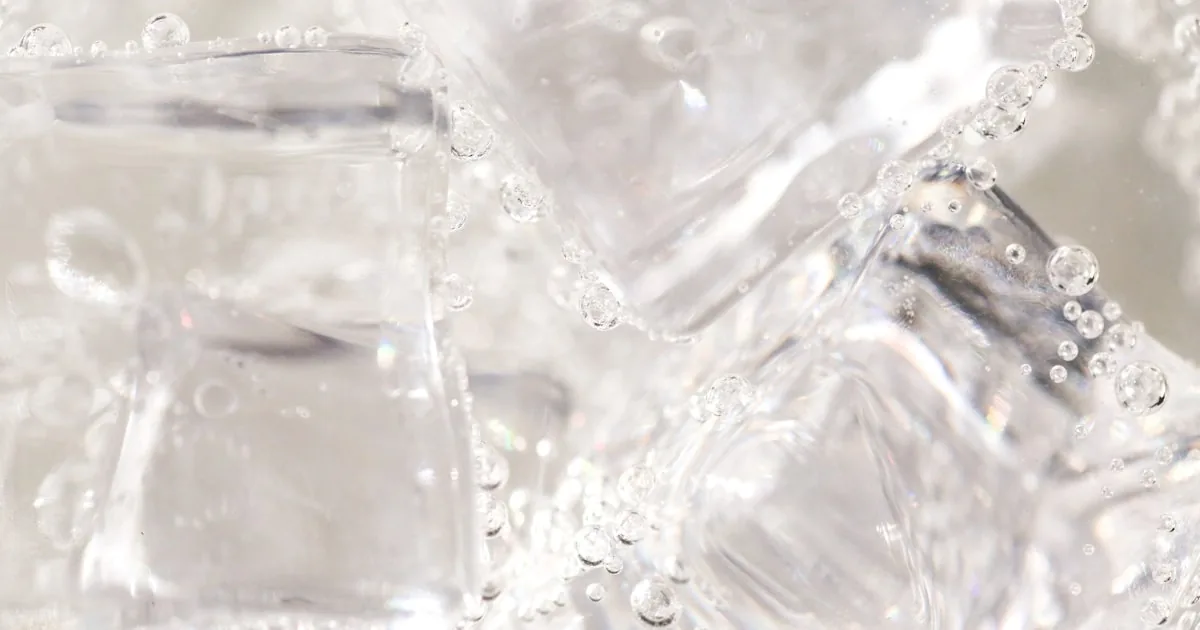
Have you ever stopped to wonder why the ice in your summer drink floats instead of sinking to the bottom? This incredibly mundane sight is actually a cosmic rebellion defying the fundamental laws of physics, and without it, life on Earth wouldn't exist.
Let's look closely at a glass of iced tea on a hot afternoon. You drop a few transparent cubes into the liquid, they plunge for a brief moment, and then immediately bob back up to the surface, clinking against the glass. We see it in our drinks, we see it on frozen lakes, and we see it in photos of majestic icebergs drifting through the ocean.
But from a strictly physical perspective, those floating ice cubes are defying nature. In fact, if they behaved "normally", you wouldn't be here to drink that iced tea at all.
The Universal Rule of Packing
To understand why floating ice is so weird, we have to zoom in on how matter behaves. Everything around us—air, water, rocks—is made of tiny particles. The state of that matter depends mostly on how much thermal energy those particles possess.
Imagine a large group of people. When they are highly energetic, running and bouncing off the walls, they act like a gas. When they calm down a bit, walking around and slipping past one another, they act like a liquid. And when they finally lose their energy, stop moving, and pack tightly together to keep warm, they become a solid.
Because the particles in a solid are packed tightly together, a solid is almost always denser—and therefore heavier—than its liquid form.
- If you drop a chunk of solid iron into a vat of molten iron, it sinks like a stone.
- If you toss a frozen stick of butter into melted butter, it plunges to the bottom.
If water were a normal substance, ice would sink. But water is not normal.
The Mickey Mouse Molecule

Water is one of the most eccentric chemicals in the universe. When water cools and freezes, it doesn't shrink. It expands by about 9 percent. It becomes less dense. This is why a forgotten can of soda in the freezer will violently explode, and why pipes burst in the winter.
The secret to this bizarre behavior lies in the shape of the water molecule: H₂O. It consists of one large oxygen atom and two smaller hydrogen atoms. But they don't line up in a straight row. Instead, the hydrogen atoms attach at an angle, giving the molecule a distinct V-shape that looks uncannily like the head of Mickey Mouse.
Because of this asymmetric shape, the molecule is electrically polarized. The "ears" (hydrogen) have a slight positive charge, and the "chin" (oxygen) has a slight negative charge. Like tiny magnets, the positive end of one water molecule desperately wants to stick to the negative end of another, forming what chemists call hydrogen bonds.
The Crowded Dance Floor

Let's go back to our human metaphor. In liquid water, the molecules have enough heat energy to move around freely. Think of a crowded dance floor with fast music. The dancers are energetically slipping past each other, breaking and reforming bonds in milliseconds. Because they are moving so chaotically, they can actually get quite close to one another, filling in all the empty gaps.
But as the temperature drops, the music slows down. The molecules lose their kinetic energy.
When water cools, it initially acts like a normal liquid: it shrinks and gets denser. This continues until it hits exactly 4°C (39.2°F). At this exact temperature, water is at its absolute maximum density. It is as tightly packed as it can possibly get.
But as it cools further—down to 3°C, 2°C, 1°C—something magical happens. The molecules are now moving so slowly that the magnetic hydrogen bonds take over completely. Instead of just huddling into a messy, compact pile, the water molecules are forced to arrange themselves into a rigid, specific hexagonal lattice.
Imagine our dancers on the floor suddenly extending their arms straight out, locking hands with their neighbors to form a massive geometric grid. By extending their arms, they force everyone to step back. The rigid structure they create takes up significantly more space than when they were just jostling around.
At 0°C, the water freezes into ice. The molecules are locked at arm's length, leaving vast amounts of empty space in the grid. More empty space means less density. And because it is less dense than the liquid around it, the ice floats.
The Blanket That Saved the World
Why does this matter? Let’s imagine an alternate Earth where water behaves like a normal liquid—where the dancers just huddle tightly, and ice is heavier than water.
Winter arrives on this alternate planet. The bitter cold freezes the surface of a majestic lake. Because the ice is heavy, it immediately sinks to the dark bottom. Now, a fresh layer of liquid water is exposed to the freezing air. It, too, freezes and sinks. Over the course of a long winter, the lake continues to build ice from the bottom up, until the entire body of water is a solid, lifeless block of ice.
When summer finally comes, the sun’s warmth would only be able to melt a thin layer of water at the very top. The deep ice, insulated from the sun, would never melt. Eventually, the world’s oceans would turn into permanent, solid ice cubes. Marine life—the cradle from which all life on Earth evolved—would have been utterly impossible. Earth would be a barren, white wasteland.
A Molecular Miracle
Instead, our world was saved by the V-shape of a molecule.
When winter strikes, the coldest water (below 4°C) expands, becomes lighter, and rises to the top to freeze into a floating sheet of ice. This floating ice acts as a perfect insulating blanket. It blocks the frigid winter air from reaching the water below, ensuring that the depths of the lake or ocean remain a cozy, liquid 4°C.
Beneath that frozen ceiling, fish continue to swim, plants continue to photosynthesize, and ecosystems thrive in the dark, waiting patiently for spring.
The very structure of our biosphere, the evolution of complex organisms, and the existence of humanity all hinge on this tiny molecular quirk. Nature is full of grand, sweeping forces, but sometimes the most profound hero is a microscopic anomaly.
The next time you sit back on a warm day and hear the gentle clink of ice against your glass, take a moment to raise a toast. You are looking at the beautiful, rebellious exception to the rules of the universe—the floating miracle that made your life possible.



Loading comments…