
Have you ever tried to hold water in your open palm? No matter how tightly you squeeze your fingers together, the liquid leaks through every crevice until nothing remains but a fading coolness on your skin. Life often feels like that fleeting handful of water. We try desperately to freeze moments, to hold onto relationships in their golden phases, and to keep ourselves unchanged against the passage of years. Yet, the world around us is in constant motion, quietly shifting like tides beneath the moon.
In this essay, we explore how ancient philosophy—from Heraclitus to Marcus Aurelius—offers a pathway to serenity not by building dams against change, but by learning to swim with life's natural current.
The River That Never Stands Still
Over two thousand five hundred years ago, the Greek philosopher Heraclitus sat by the banks of the river Ephesos and made an observation that would echo through millennia: "No man ever steps in the same river twice, for it's not the same river and he's not the same man."
At first glance, the statement sounds simple, almost poetic. Yet, it contains a profound psychological truth. When we look at a river, we perceive a singular, permanent object. We give it a name, trace its path on a map, and speak of it as if it were static. But in reality, the water you touch right now is already miles downstream a heartbeat later. The river is not a fixed object; it is an ongoing process.
We, too, are rivers. The person who woke up this morning is subtly different from the one reading these lines right now. Millions of cells have divided, new thoughts have crossed your mind, and unseen emotional currents have shifted your spirit. Our suffering often begins when we mistake ourselves and our lives for static rocks rather than flowing streams. We demand that people remain who they were yesterday, that joy remain fixed, and that stability mean the absence of movement.
The Stoic Acceptance of Life's Flux

Centuries after Heraclitus, the Roman Emperor and Stoic philosopher Marcus Aurelius reflected on the same impermanence while governing a vast empire amidst plague and war. In his private journal, Meditations, he wrote: "Time is a river, a violent current of events, glimpsed once and already carried past us, and another follows and is gone."
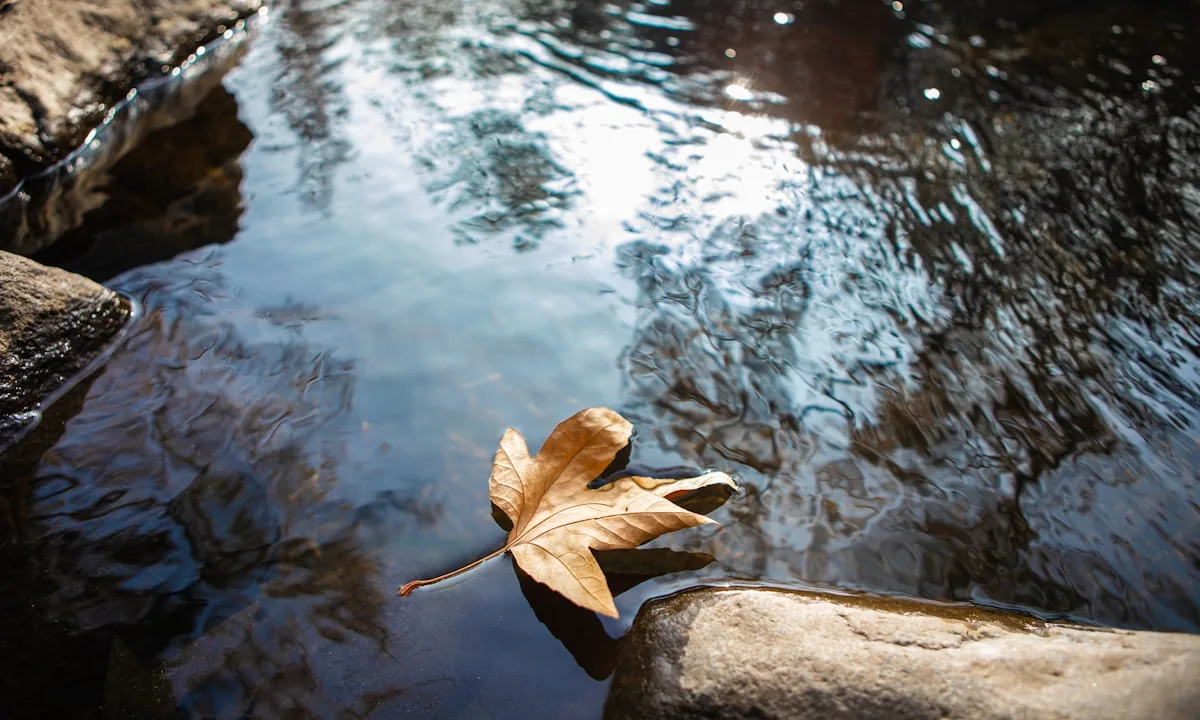
For Marcus Aurelius, impermanence was not a cause for despair, but the fundamental law of nature. He observed that everything we experience—our victories, our heartbreaks, our possessions—is subject to the quiet machinery of transformation. A leaf turns golden, falls to the earth, nourishes the root, and gives birth to fresh green shoots in spring. Nothing is truly destroyed; it is merely rearranged.
Why then do we fear change so deeply? Because human instinct equates change with loss. We grieve the end of a chapter because we focus solely on what is departing, forgetting that every departure creates the space for a new arrival. When a season ends, it does not mean the forest has died; it means the earth is preparing for another rhythm. When we resist change, we spend immense energy fighting against the universe itself.
The Freedom of Unclasping Your Hands
How do we practice peace in a world where everything shifts? The answer lies not in detachment that cold-heartedly ignores love, but in a deeper, more mature engagement with the present.
Consider a cup of tea. If you know that the porcelain cup will eventually crack or break—whether tomorrow or ten years from now—does that knowledge ruin the experience of drinking from it today? Or does it make this single, quiet morning moment infinitely more precious? When we acknowledge that moments are transient, we stop taking them for granted. We listen more intently to a friend's voice, we look more carefully at the evening sky, and we cherish warmth while it lasts.
To embrace impermanence is to unclasp our hands. We stop grasping at people and circumstances, demanding that they guarantee us an unchanging future. Instead, we learn to harbor what Stoics call an "inner citadel"—a quiet sanctuary of character and awareness that remains anchored even as the outer landscape transforms.
Walking with the Current
The art of living is not about mastering the storm, but about becoming light enough to move with the wind. When you feel anxious about an uncertain future or sorrowful over a past that has slipped away, remember the river.
Do not fight the water. Step into it with reverence, honor the current for where it carries you, and trust that impermanence is not an enemy that steals our joy, but the very condition that makes life beautiful, dynamic, and real.


Loading comments…