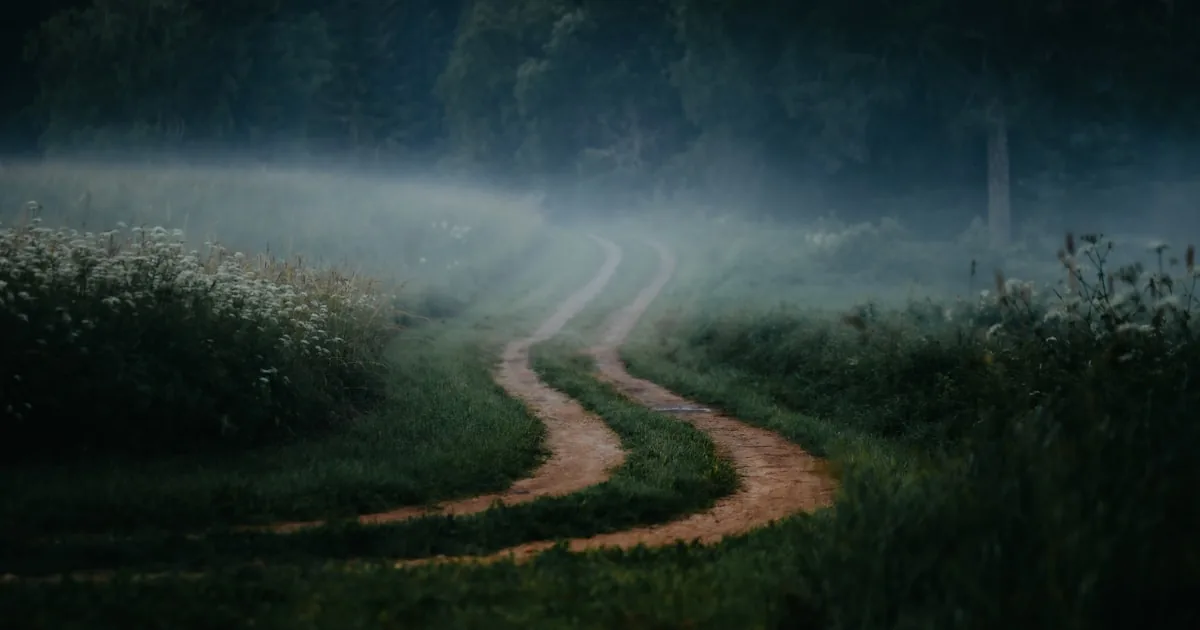
We often view life’s delays, detours, and sudden interruptions as frustrating obstacles to our goals. Yet, in both Stoic reflection and Eastern philosophy, the indirect path is not a waste of time, but the very place where wisdom is forged.
The Myth of the Straight Line
We live in a culture obsessed with the shortest distance between two points. We design our careers, daily routines, and life plans like high-speed railways—straight, efficient, and bound to a strict timetable. When a bridge collapses or an unforeseen delay forces us onto a slow, winding country road, our immediate reaction is anxiety. We feel that every minute spent away from the main highway is a minute stolen from our progress.
But has any meaningful life ever unfolded in a straight line?
When we look back at the moments that truly shaped our character, we rarely find them in the smooth execution of our plans. They exist in the unexpected detours: the project that failed and led to a new craft, the long illness that forced us to sit with ourselves, the wrong turn in a strange city that revealed an unseen alley of beauty. The straight line delivers us to a destination, but it is the curve that invites us to observe.
What Stands in the Way Becomes the Way
In Book V of his Meditations, the Roman Emperor and Stoic philosopher Marcus Aurelius penned a reflection that has echoed through two millennia: "The impediment to action advances action. What stands in the way becomes the way."
Marcus Aurelius did not write these words from a quiet villa; he wrote them while commanding military campaigns on the frozen northern frontier, facing plagues, betrayals, and political chaos. For the Stoics, an obstacle is not a sign that you have lost your way; it is the material out of which character is forged. When a detour forces you to stop running, it demands a different kind of movement: inward observation, patience, and adaptability.
Seneca, writing to his friend Lucilius in Letters from a Stoic (Letter 107), echoed a similar sentiment: "Fate leads the willing and drags the unwilling." When life reroutes us, struggling against the detour does not return us to the main road; it only doubles our fatigue. Accepting the detour allows us to examine the new terrain with clarity rather than resentment.
The Wisdom of the Gnarled Tree
Across the globe, the Daoist sage Zhuangzi offered a complementary perspective through the story of the gnarled tree in the Inner Chapters. A carpenter walked past a giant tree with twisted branches and knotty trunk, dismissing it as useless because its wood could not be crafted into beams or boats.
Yet Zhuangzi pointed out that precisely because the tree was crooked and unsuitable for commercial timber, no lumberjack would ever cut it down. It grew ancient, vast, and majestic, providing shade for travelers beneath its broad canopy.
Our modern obsession with utility makes us view detours as useless loops in our itinerary. We ask: What does this delay produce? What goal does this detour serve? But Zhuangzi reminds us that not all value is measured by linear progress. The crooked path offers shelter from the frantic pursuit of efficiency. It teaches us Wu Wei—the art of effortless action, of yielding to the contours of reality rather than hammering through them.
Reclaiming the Present from the Arrival
Why are detours so agonizing to the modern mind? Because we have trained ourselves to live exclusively in the future. We treat the present moment merely as a bridge to be crossed, a temporary sacrifice on the altar of tomorrow’s achievement.
When a detour occurs, it destroys the illusion of control. It breaks the momentum of our forward projection and grounds us in the immediate now. Suddenly, we cannot rely on our pre-written script. We are forced to look at the trees along the side road, to listen to the unfamiliar sounds, to breathe in the air of an unplanned afternoon.
If life is only worthwhile at the destination, then the vast majority of our journey is rendered meaningless. The detour restores dignity to the journey itself. It insists that this unexpected hour, spent waiting or taking the long way around, is just as sacred as the moment of arrival.
Walking the Unplanned Road
The next time life pulls you off your carefully charted course, consider holding back your protest. Do not ask immediately how quickly you can return to the highway. Instead, take a quiet breath and ask a different question: What is this landscape asking me to notice?
The detour is not an interruption to your life; it is your life unfolding in a key you did not compose. In the quiet bends of the unplanned road, away from the dust and speed of the main highway, we often discover the very things we did not know we were looking for.



Loading comments…